
What was once the British Isles is now a collection of slightly smaller islands which contain twenty or more self governing territories. The major, advanced territories are Wolfland, Mannin, Meirionnydd and Leinster, where there has been a resurgence in the use of native languages, English, Manx, Welsh and Gaelic.
Beyond these prosperous places you have The Pennites. It’s a vast and sparsely populated area running from Skipton to Otterburn. Both Wolfland and The Pennites have a southern border with a bunch of trouble makers.
Across the entire world, food was once in short supply, so territories tried to become self sufficient. After The Great Famine, they began to trade surplus goods with one another, and commercial shipping took off again. With climate change, the warmer weather has led to vineyards in Meirionnydd and Mannin. They both produce wine and champagne, each asserting that theirs is the best. You can also get port and sherry from Mannin.
The sugar cane plantations in Leinster extend across vast arable plains to the west. The warmer weather means that coffee beans can also be grown. The Wicklow Mountains are home to a pretty pattern of tea plantations and rice paddies. There is tea on Mannin too, and they claim to produce tea leaves of the same quality as Darjeeling and Assam. Which is just as well, because India is a long way away and nobody knows if it’s still inhabited.
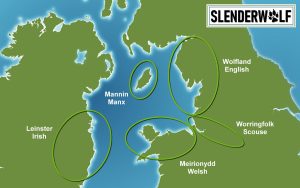 Not to scale. The boundaries are for general guidance only and are not exact.
The Wolfies (and everybody else) are delighted that they can still buy tea and coffee! The produce that comes from Mannin is pricier than elsewhere, but they have a niche market, and as a result the Manx economy is thriving.
In Meirionnydd the town of Amlwch has grown massively now that the copper mines are viable again. The island of Mona, and the whole of the Meirionnydd coast are alive with commerce and thriving towns.
Territories have shrunk. Governments have changed. They’ve downsized and localised, and they are run by the people for the people. In the Post Oil Era there is ample timber in the right places and enough clean drinking water in the right places. However, there’s not enough copper. And there’s a newfound concern about the welfare of wolves.
Inconveniently sandwiched between these trading partners is Worringfolk! They have a reputation for being a backward, moronic society. It’s a turbulent place, run by the warlord in chief ThunderCloud and his pirates. Generally, the inhabitants are poor and unhappy, and they covertly refer to ThunderCloud as Mr Potato Head!
London and South East are desolate places due to the lack of safe drinking water. The few Swampies who still live there seem to have constant friction with the Chalkies who live on the coast of Kent. They’re too far away from Wolfland to worry about, and they’re too preoccupied with their own problems to cause any difficulties for the Wolfies.
Around the Irish Sea, trade is conducted by the Cedyrn in Meirionnydd, the Manx in Mannin, and the Irish in Leinster. And the Wolfies obviously!